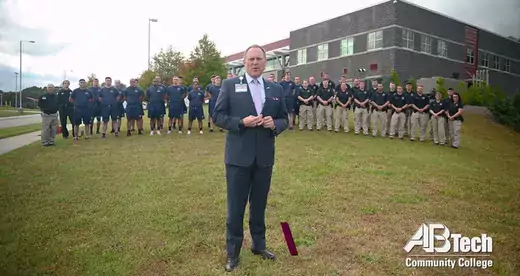
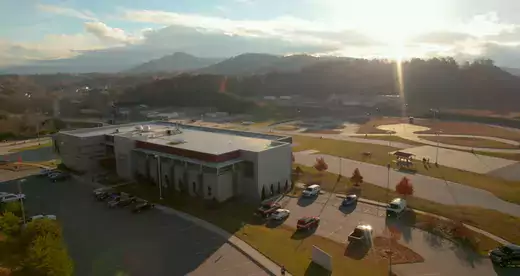
This curriculum is designed to provide practical knowledge of criminal justice systems and operations. The study will focus on local, state, and federal law enforcement, judicial processes, corrections, and security services. The criminal justice system's role within society will be explored.
Emphasis is on criminal justice systems, criminology, juvenile justice, criminal and constitutional law, investigative principles, ethics, and community relations. Additional studies may include issues and concepts of government, counseling, communications, computers, and technology.
Protect Communities. Pursue Justice. Build Your Future.
Whether you're beginning your college journey, changing careers, returning to school, or preparing for advancement in the criminal justice profession, A-B Tech's Criminal Justice Technology program provides the knowledge, practical skills, and academic foundation to help you achieve your goals.
Graduates pursue careers in law enforcement, investigations, forensic science, courts, corrections, victim services, homeland security, intelligence, and many other criminal justice professions while building a strong foundation for continued education.
Programs
| Title | Credential | Credit Hours | Link to program details |
|---|---|---|---|
| Criminal Justice Technology A.A.S. | Degree | 65 | |
| Criminal Justice Technology Certificate | Certificate | 18 | |
Career Opportunities
Employment opportunities exist in a variety of local, state, and federal law enforcement, corrections, and security fields. Examples include police officers, deputy sheriffs, county detention officers, state troopers, intensive probation/parole surveillance officers, correctional officers, and loss prevention specialists.
Good to Know
James A. Crawford's Bio
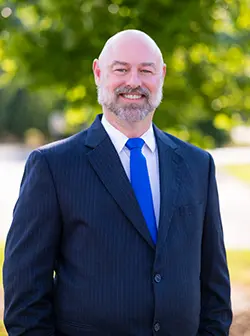
James A. Crawford, Ph.D., serves as Chair of the Criminal Justice Department at Asheville-Buncombe Technical Community College (A-B Tech), where he teaches courses in criminal law, constitutional law, corrections, juvenile justice, investigations, ethics, and other areas of the criminal justice curriculum. He is committed to preparing students for successful careers in law enforcement, corrections, investigations, and related public safety professions through practical, experience-based instruction that bridges academic theory with real-world application.
Dr. Crawford earned his Ph.D. in Criminal Justice with a specialization in Behavioral Science and brings more than a decade of higher education teaching experience together with seven years of service in county corrections, where he served as a detention officer, trainer, and sergeant. He is also a United States Marine Corps veteran and former martial arts instructor, experiences that continue to influence his leadership philosophy, instructional approach, and commitment to public service.
As Department Chair, Dr. Crawford serves on the A-B Tech Criminal Justice Advisory Board, collaborating with representatives from local criminal justice agencies throughout the college's service area. Working alongside these professionals, he helps evaluate workforce trends, identify emerging training needs, and strengthen the Criminal Justice curriculum to ensure students graduate with the knowledge, skills, and competencies sought by today's criminal justice employers.
In addition to classroom instruction, Dr. Crawford enjoys mentoring students as they explore the many career paths available within the criminal justice profession. He regularly advises students interested in careers in law enforcement, detention and corrections, probation and parole, criminal investigations, crime scene investigation, forensic and crime laboratory services, victim advocacy, criminology research, and transfer opportunities to four-year universities and graduate programs. His goal is to help each student identify a career path that aligns with their interests, strengths, and long-term professional aspirations.
His research focuses on corrections, vulnerable populations, correctional safety, LGBTQIA+ issues within the criminal justice system, qualitative research methods, and criminal justice education. He is an active presenter at regional and national conferences and remains engaged in advancing scholarship, evidence-based practice, and excellence in criminal justice education.
Dr. Crawford is an active member of the Academy of Criminal Justice Sciences (ACJS) and participates in the Community College, Victimology, and Minorities and Women Sections. He is also a member of the American Society of Criminology (ASC) and participates in the Corrections, Victimology, and Division of Queer Criminology. He currently serves as an Executive Counselor for the ASC Division of Queer Criminology, contributing to national initiatives that support research, scholarship, and professional development within the field. Additionally, he is a member of the Southern Criminal Justice Association (SCJA) and the North Carolina Criminal Justice Association (NCCJA).
Dr. Crawford is dedicated to developing innovative educational opportunities, strengthening partnerships between higher education and criminal justice agencies, expanding transfer and workforce pathways for students, and preparing the next generation of ethical, knowledgeable, and community-focused criminal justice professionals. He believes the most effective criminal justice education combines academic rigor, ethical leadership, and practical experience to prepare graduates who can successfully serve both their communities and the profession.
A Career-Focused Education
- Faculty with extensive real-world criminal justice experience
- Flexible online and in-person learning options
- Affordable tuition and financial aid opportunities
- Career-focused curriculum
- Transfer pathways to four-year universities
- Strong partnerships with regional criminal justice agencies
- Supportive environment for new and returning students
Criminal Justice offers far more than one career.
Select the area that interests you and discover where your education can take you.
Law Enforcement
Protect communities and uphold the law.
Examples
- Police Officer
- Deputy Sheriff
- State Trooper **
- Campus Police **
- School Resource Officer
- Federal Law Enforcement **
Investigations
Solve crimes through evidence, analysis, and investigative techniques.
Examples
- Detective
- Criminal Investigator
- Fraud Investigator
- Crime Analyst
- Private Investigator
- Intelligence Analyst
Behavioral Analysis
Study criminal behavior and support complex investigations.
Examples
- Behavioral Analyst **
- Criminal Profiler **
- Threat Assessment Specialist **
- Crime Analyst **
- Criminologist **
Crime Scene & Forensic Science
Collect, analyze, and preserve evidence.
Examples
- Crime Scene Investigator
- Crime Scene Technician
- Evidence Technician
- Digital Forensics Examiner **
- Fingerprint Examiner **
- DNA Analyst **
Courts
Support the judicial process and community supervision.
Examples
- Probation Officer
- Parole Officer
- Court Administrator
- Pretrial Services
- Court Services
Corrections
Promote safety, accountability, and successful reentry.
Examples
- Correctional Officer
- Detention Officer
- Classification Officer
- Reentry Specialist
- Juvenile Justice Officer
Victim Services
Support victims and families through advocacy and crisis intervention.
Examples
- Victim Advocate
- Domestic Violence Advocate
- Sexual Assault Advocate
- Child Advocacy Center
- Crisis Intervention
Homeland Security & Public Safety
Protect critical infrastructure and prepare for emergencies.
Examples
- Homeland Security Specialist
- Emergency Management
- Transportation Security
- Border Protection
- Protective Services
Corporate & Private Security
Protect organizations, people, and assets.
Examples
- Corporate Security
- Asset Protection
- Compliance
- Risk Management
- Executive Protection
Research & Higher Education
Advance knowledge and help shape the future of criminal justice.
Examples
- Criminal Justice Professor **
- Criminal Justice Researcher **
- Policy Analyst **
- Behavioral Researcher **
- Criminologist **
** Some careers require additional education and professional experience beyond an associate degree. A-B Tech provides the academic foundation for continued education and career advancement.
Students develop knowledge and practical skills in:
- Criminal Law
- Constitutional Law
- Criminal Investigations
- Crime Scene Investigation
- Community Policing
- Corrections
- Juvenile Justice
- Homeland Security
- Criminal Justice Ethics
- Critical Thinking
- Professional Communication
- Emerging Technologies in Criminal Justice
James Crawford, Criminal Justice Department Chair
24 Canoe Lane
Asheville, NC 28804
- Phone: (828) 782-2350
- Email: jamesacrawford@abtech.edu