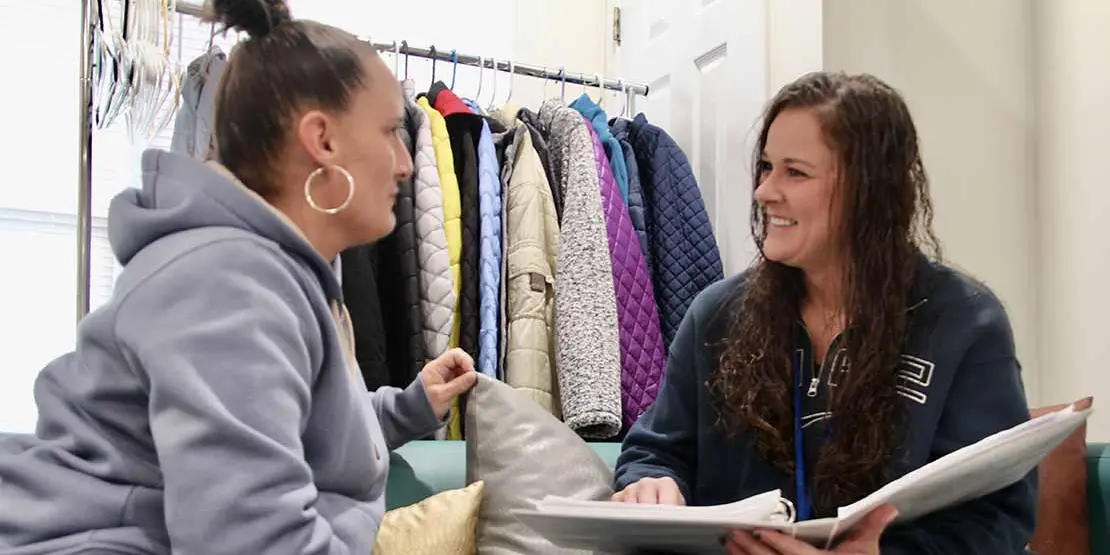
When Brandy Smiley was released from prison in April, she came to the Asheville women’s shelter, Transformation Village, unsure of her future. The former accountant,44, knew she’d like to go back to school to gain more experience, but wasn’t sure what to study or how she could afford college.
Just eight months later, Smiley has her own apartment, is enrolled in A-B Tech’s Social and Human Services program, and has a paid apprenticeship at ABCCM’s Transformation Village. In her work as a peer support specialist at Safe Haven, the nonprofit’s emergency crisis shelter, she helps connect women with resources like jobs, housing, and food.
“It's about stabilizing the person at that moment,” she said. “Giving them baby formula, making sure their kids are fed, and they have a place to sleep. Then they can go on to think about higher levels of need.”
Smiley's behavioral health apprenticeship is the first of its kind in North Carolina, according to Porscha Orndorf, A-B Tech’s Social and Human Services department chair. It addresses a statewide need for mental health care workers during a time when there are record shortages. According to the Department of Health and Human Services (NCDHS), 40 percent of North Carolina residents live in an area where there is a shortage of mental health care services. Moreover, 68 counties lack child psychiatrists, a fact even more alarming given that the suicide rate is two times higher among rural youth.
Orndorf said the new behavioral health apprenticeship was made possible by a legislative rule change passed by the N.C. General Assembly. As of this summer, individuals who hold an associate degree in human services and have at least two years of experience will be able to qualify as Qualified Professionals (QP) in mental health care fields, which include psychiatrists, psychologists, and social workers. According to Orndorf, these licensed roles still require a four-year degree, but now students with an associate's degree can help to fill in gaps in mental health care.
A-B Tech’s Social and Human Services graduates also may also in some ways be “better qualified than someone with a BA in Psychology,” Orndorf said. “They have more Human Services credits, and instead of taking four psychology courses, they’re learning crisis intervention and interviewing skills.”
The new apprenticeship will make it possible for future students to earn money while working toward their degree and gaining valuable work experience. When they graduate, they will be eligible to work in a wide variety of QP roles. Options include working with autistic children at home, as a substance abuse counselor at a clinic, or as a peer support specialist in a homeless shelter. Orndorf said the salary range for QP jobs is $40,000 to $60,000.
Students attracted to the behavioral health field often have personal experience with mental health challenges, addiction, and trauma, which makes them a valuable source of knowledge and resources. Smiley has lived experience that plays directly into her new role. Orndorf, who is Smiley’s student adviser, said, “Brandy has experience being unhoused, so she is a safe person. She’s lived through the experience.”
The fact that Smiley is open about sharing her story makes her all the more valuable in her new role. Recently, the Tennessee native shared her story in a public event at Transformation Village before a crowd of many donors, volunteers, and community members. She told how in her twenties she began taking opiates with a boyfriend who used them at the time. Over the years, Smiley went from taking one pill as a means of connecting with her partner to relying on drugs regularly as a means of escape from life’s pain.
In her thirties, Smiley began reselling pills to support her own addiction and wound up serving a three-year prison sentence. When she was released, she vowed to stay clean. For a while, she did well, but her mother’s sudden death caused her to relapse.
“I didn’t know how to process the pain,” she said. “Lost in grief, and unable to navigate life after her death, I turned back to the only thing I knew could numb the pain: drugs.”
At the time, Smiley was also in an abusive relationship that she desperately wanted to leave. She prayed that God would help her leave him and give her another chance to start over. One day, she and her boyfriend were pulled over, and the police found a backpack of drugs in the trunk of their car. Smiley was charged with seven felonies and five misdemeanors.
Sentenced to another three years in prison, Smiley was sent to Anson Correctional, where early in her term she met a woman who told her how Transformation Village helped women transition back into life after prison. During her three-year sentence, Smiley tightly clung to the idea of going to Transformation Village.
“I knew I needed a different path if I wanted a different future,” she said.
Four months before her release date, she called Transformation Village and put her name on the waiting list. Luckily, there was an opening, and her dream of a new life came to fruition. At Transformation Village, Smiley was welcomed with open arms and “given more love than I ever expected.” Just one month after arriving, she was offered a job as a resident assistant, a role where she began to get to know her fellow residents and their needs.
In her new role, Smiley is learning how to manage a caseload of up to 20 residents. She will meet with them weekly to learn their individual needs and goals for education, employment, and re-entry into the workforce. She works 9 a.m. to 5 p.m. Monday through Friday while juggling four online Social and Human Services classes. It’s a busy schedule, but her work is deeply satisfying.
Before her prison term, Smiley worked as an accountant and mechanic for her father’s garage, TJ’s Truck and Auto Repair in Bluff City, Tennessee. She enjoyed working with numbers and fixing cars, but now she feels she’s satisfying a deeper spiritual calling.
“God keeps leading the way and opening doors for me,” she said.
Her favorite part of the job is seeing how women relax after three weeks at Safe Haven. Without the demands of living on the street, they are able to feel safe for the first time and be their true selves.
“I want to show women that if you have ambition and want it, there is a better life,” she said. “I’m living proof.”
An added benefit is being able to give back to her beloved community at Transformation Village, which she credits for her new life.
When she thinks back on her last prison term, she now sees it as a blessing. “Some might look on (the day I was arrested) as the worst day of their life, but for me it was an answered prayer,” she said. “It wasn’t the way I imagined God would save me, but it was exactly what I needed.”
Criminal justice reform advocate Phillip Cooper recalls meeting Smiley the day after she was released from prison. At that time, he was struck by her composure and confidence in sharing her story. In the following months, Smiley joined Cooper at recovery events across the state with Operation Gateway, a nonprofit that helps prisoners build new lives after being released. Cooper said he was impressed by her willingness to share her recovery story again and again with boldness and clarity. “She has a natural ability to speak from the heart and does it articulately,” he said.
When the new A-B Tech apprenticeship was created, Cooper unhesitatingly recommended Smiley for the position. He’s not surprised to hear that she’s thriving in her new role.
“She’s glowing, and she’s on fire,” Cooper said. “Not because she changed who she was, but because she’s always been optimistic, faithful, and outspoken about recovery. She just needed the space to grow. Watching her get her credentials and build herself up in this field has been truly inspiring.”
Learn more at Social and Human Services.