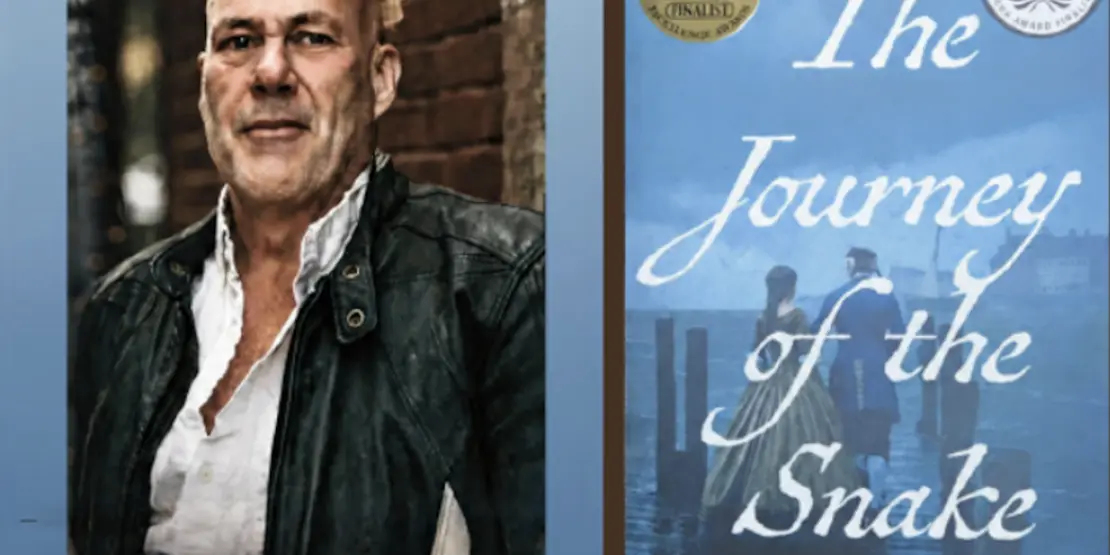
Adam Smith is a New England-based author who presently lives on Cape Cod. His first novel, Scabland, was placed as a Finalist in several literary competitions, including the prestigious Next Generation Indie Book Awards. Smith will visit Locke Library on November 2 from 4:00 p.m. to 5:00 p.m. for an author reading presented by A-B Tech’s History Society. He will be reading from his 2025 book “The Journey of a Snake”, which reimagines Emily Brontë’s Wuthering Heights, placing Heathcliff in Revolutionary America.
Q: What inspired this book?
A: I wondered how a young woman in the colonial 1700s would cope with a psychosomatic condition, in this case, sudden, inexplicable bouts of blindness, without the aid of modern psychoanalysis.
Q: Do people need to have read "Wuthering Heights" to understand this book?
A: It is not necessary to read Wuthering Heights. Heathcliff has a supporting role. Knowing his backstory would, of course, add to the experience of seeing that deviant back in action. Readers of Wuthering Heights know that Heathcliff disappears for three years and returns filthy rich. But Emily Brontë never reveals where Heathcliff went nor how he made his money. My story does. He came to Revolutionary America. Ultimately, The Journey of the Snake is a mystery, but solving it requires the main character, Charlotte Savatier, to cope with her personal grief.
Q: How did you come to be a writer?
A: In second grade, my father gave me his copy of Bram Stoker’s Dracula. I was hooked. I’ve been writing ever since.
Q: Do you work another job in addition to writing?
A: Yes, I am a chef. I’ve owned restaurants, but I am currently the chef at a private residential community, working 32 hours a week. Being a chef is similar to writing because it's all about creating from scratch.
Q: What is your writing routine?
A: I write every day, starting early, between 4 and 5 a.m. The chef shift starts at noon.
Q: Who is this book written for?
A: It's for a general adult audience that enjoys mysteries, but it also leans toward literary readers who enjoy personal journeys of self-discovery.
Q: Who are a few of your favorite authors? How have they shaped your own writing if at all?
Carl Jung, Schopenhauer, Nietzsche, Kurt Vonnegut, Robert A. Heinlein, Joseph Kanon, J.M. Coetzee, Leonard Elmore, T.S. Eliot, Graham Greene, Cormac McCarthy.
My favorite book has to be Mary Shelly‘s Frankenstein.
Carl Jung’s analysis of symbols and dreams has always fascinated me. Reading and rereading his writings is like reaching into a black swamp: you never know what you'll come out holding. I’ve learned from Jung to make symbols part of the story, a functioning part, and never draw attention to them. Like images in our dreams, each has its own power and meaning.
Q: Is there anything you can tell us in advance that might help us prepare for your reading?
A: The main character is half Native American, a fictional “Wacataw,” based on the Catawba Indians of the Carolinas.