A student experiment from A-B Tech is bound for outer space on Tuesday, October 13, as part of the Student Spaceflight Experiments Program (SSEP) that will have experiments from 21 colleges aboard a SpaceX rocket. The launch is currently set for approximately 6:33 a.m. at the Cape Canaveral Space Force Station, which adjoins the Kennedy Space Center in Florida.
A-B Tech chemistry instructor Evan Lunt will join physics student Curtis Epley to watch the launch in person with about 70 other students, teachers, and guests. The SpaceX CRS-35 rocket will deliver the experiments to the International Space Station (ISS), where they will be tested in zero-gravity conditions. This phase of the SSEP project is the Mission 21 to ISS Discovery experiments payload.
“This will be a spectacular launch before sunrise and before civil twilight when the sky starts to become noticeably bright,” according to a SSEP launch message. “Watching a launch with your community’s experiment and mission patches aboard is a life-changing experience. At the launch viewing area, we will also have a Jumbotron that will carry the launch live on NASA TV, with pre-launch commentary, tracking of the rocket over its path to Low Earth Orbit, and coverage of the return to Earth and landing of the Falcon-9 first stage.”
A-B Tech’s experiment, which examines how lubricating oils respond to gravity, was developed by three physics students led by Epley, a Diesel and Heavy Equipment Technology student who is training to be a truck mechanic and diesel engine specialist. Physics instructor Shannon Bonomi, who initiated the project, said the experiment’s aim is to give astronauts more options for lubricating spaceship mechanisms, including engines, pipes and other moving parts.
Student teams across the United States and other nations designed experiments in diverse fields, including seed germination, crystal growth, and cell biology. A-B Tech’s experiment was selected in December 2025, and Epley has been refining it for several months.
Lunt is playing a role in the experiment process as well. He will conduct his own version of the experiment with the lubricant here on Earth, keeping a test tube in his A-B Tech office. “This is so we can compare how it reacts on Earth versus in zero gravity,” he said. “The experiments will be up in the space station for a week or two, then they send them back down, and they get shipped back to us so we can compare the space tubes with the ones down here.”
Lunt said that as a scientist himself who is interested in space, he is excited to be involved. “Curtis has done an incredible job,” he said. “I am proud to be able to support him. With the incredible caliber of experiments submitted, for him to be participating is amazing.”
Two colorful mission patches will accompany A-B Tech’s experiment to space, both of them winners in a student design competition last spring. Space flight mission patches have been a NASA tradition since 1965, when the first patch, featuring a covered wagon, a symbol of pioneering, was designed by astronaut Gordon Cooper.
About SSEP
The Student Spaceflight Experiments Program [or SSEP] is a program of the National Center for Earth and Space Science Education (NCESSE) in the U.S. and the Arthur C. Clarke Institute for Space Education internationally. It is enabled through a strategic collaboration with Rhodium Scientific, America’s first commercial space biotech company. SSEP is the first pre-college STEM education program that is both a U.S. national initiative and implemented as an on-orbit commercial space endeavor. Research reported herein was supported by the Center for the Advancement of Science in Space, Inc. and NASA under agreement number 80JSC018M0005 and with Rhodium Scientific under agreement number UA-2021-8282. To learn more, visit SSEP | Student Spaceflight Experiments Program.
Editor's Note: For a dedicated launch page with updated information about the SpaceX CRS-35 launch and SSEP project, visit Launch Viewing Plans for SpaceX-35 and Flight of SSEP Mission 21 ‘Discovery’ Experiments Payload.
Any changes in the launch date or time will be made here in real time on this page, which includes countdown clocks.
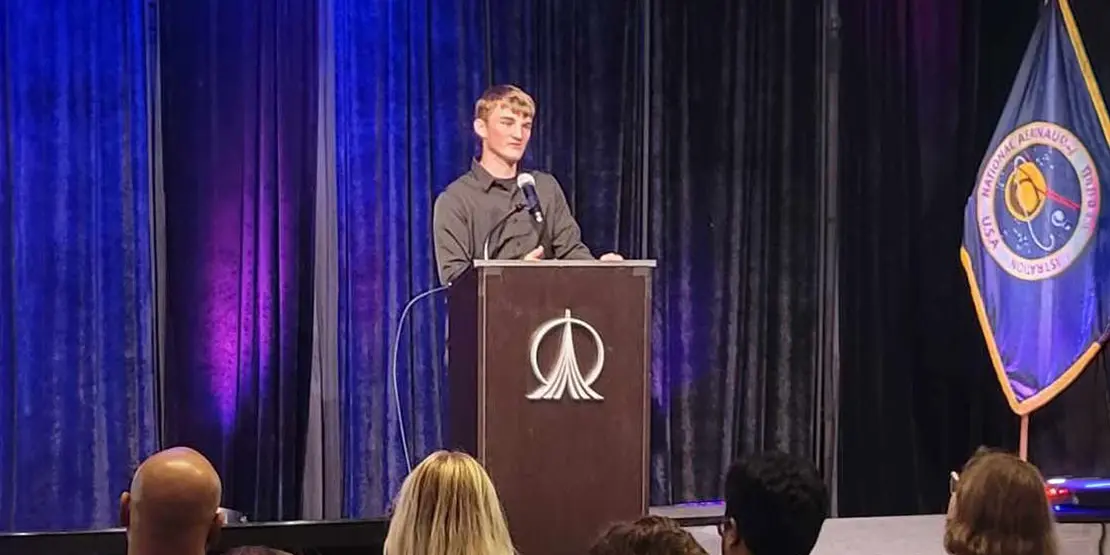
Pictured above: On June 29, A-B Tech physics student Curtis Epley gave a presentation about his experiment at this year's Student Spaceflight Experiments Program's (SSEP) National Conference at the Kennedy Space Center Visitor Complex in Florida.