As AI Gains Ground Among WNC Businesses, Questions About Jobs Remain
Posted on the Mountain Xpress on November 6, 2926.
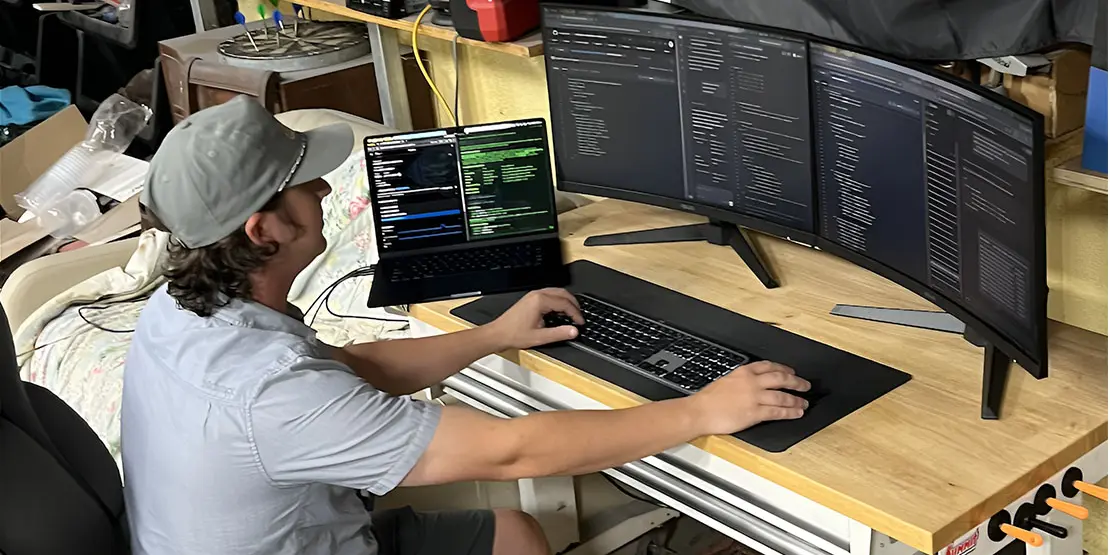
Kavik Carter wraps cars, tints windows, and details vehicles at Kavik’s Customs. But behind the scenes, artificial intelligence (AI) is taking on some of the less glamorous work of running the Black Mountain business.
Carter has used his company as a testing ground for AI, building a database to track customer invoices, projects, and employees and using the technology to streamline administrative tasks.
“Being a business owner, I have to wear a lot of hats,” says Carter, who also works in the applied AI department at Asheville-based Nomadic Marketing + Software as a technical engineer and is studying AI at A-B Tech. He says the technology frees up his time for more creative work by allowing him to quickly handle tasks that might otherwise amount to a full-time job for another person.
Carter is among a growing number of Western North Carolina business owners experimenting with AI. A recent Mountain BizWorks survey of more than 700 WNC business owners who had engaged with the organization or received storm recovery assistance found that 62% had tried the technology and 32% were using it regularly. Roughly a quarter said they weren’t using AI and had no plans to start.
Nationally, AI adoption is also widespread. An October report from the U.S. Chamber of Commerce found 66% of small businesses were using the technology, although differences in survey methods make direct comparisons with WNC difficult.
Those who are embracing it are finding uses that extend beyond the AI-generated writing and images that have drawn much of the technology’s attention. Local businesses and organizations are using AI to organize and retrieve information, automate administrative work, analyze data, and eliminate repetitive steps from existing workflows.
But the same capabilities that can save businesses time and money are fueling concerns about what AI could eventually mean for workers.
Local business owners, technology professionals and educators describe a technology that could make employees more productive and change the work they do, while leaving unresolved whether businesses will ultimately need fewer people to do it.
“What aspects of the job is it taking away? And what leverage do we still have?” asks Scott Burroughs, who is already seeing AI move beyond simple administrative tasks at This Land Studio, his Asheville architecture firm. “What value do we still add, if it [AI] can do a passable job?”
For Carter, that tension is already part of his work at Nomadic Marketing + Software. He says the company tries to use AI to automate work surrounding decisions rather than allowing the technology to make those decisions itself.
Beyond the Busy Work
Burroughs says he and other local architects use AI to help write emails and project descriptions, review contracts and other large documents, and research unfamiliar building-code questions. The subject generated enough interest that in August he led a discussion on AI in architectural practice for the WNC chapter of the American Institute of Architects.
“It’s great at pointing you in the direction,” he says. “It’s not great at actually answering your question.”
Architectural rendering is where Burroughs has seen a more dramatic change. He remembers when firms hired watercolor artists to create renderings, then shifted to computer-generated images and later to overseas companies that could turn around the work overnight. Now AI can do much of that work almost instantly.
Burroughs estimates that about 70% of the time, AI rendering tools produce exactly what he wants.
Clients are experimenting with the technology, too. Burroughs says some now arrive with AI-generated images to illustrate what they want, although the designs aren’t always practical — or even possible — to build.
Other local organizations are finding uses for AI far removed from architecture. At Nomadic, Carter says the biggest demand he’s seeing involves helping businesses find and organize information scattered across different software systems.
“The biggest thing I’m seeing is just surfacing data,” Carter says. Businesses, he says, often don’t realize how much information they already have or where to find it.
Carter says one local retail organization he worked with had an employee spending about 20 hours a week coordinating appointments for 1,300 vendors before AI substantially reduced that workload. At Black Mountain Home for Children, AI is reducing the need to manually transfer information from paper binders into computers.
“We’re helping them free up time to where they can spend more time with the kids, which I think is very meaningful,” Carter says. “It’s a good use case of this kind of tool.”
That ability to eliminate hours of work leads to a more difficult question: What happens to the people who previously did it?
What Happens to Jobs?
For all the attention surrounding AI’s potential to eliminate jobs, there is no evidence — at least yet — that WNC businesses are using it primarily to replace workers.

Jack Little, data and impact officer at Mountain BizWorks, says the organization’s survey found only a small percentage of respondents currently using AI for human resources or hiring. And while the survey asked businesses how they are using AI, Little says more evidence is needed to understand how the technology is changing employees’ responsibilities.
That could change as businesses become more comfortable with the technology. A national survey of 3,022 small-business owners conducted by Careerminds found 61% believed AI could already perform a meaningful portion of the work done by at least one employee. At the same time, 61% said they had delayed adopting AI because of concerns about employees, while 59% had decided against an AI tool because it could result in job losses.
Carter says the question is already coming up in his work with businesses.
“Are we going to have to replace these people? Are we going to have to push these people out that we’ve relied on for years?” he says employers ask.
Carter argues that, at least for now, AI is more likely to change jobs than eliminate them. He sees opportunities to move employees away from repetitive work and into roles that require more judgment and oversight.
“You’re going to be able to take those people and put them in more of a managerial role,” he says, while using AI to eliminate some of the “mindless tasks” and busy work employees now perform.
Burroughs is less certain that greater efficiency won’t eventually translate into fewer workers. He believes AI could eventually take over much of the day-to-day work performed by architects.
“I think the majority of the time we spend and that we bill [clients for] is doing things that eventually it will take over,” Burroughs says. “And so I think there’ll be less architect positions in the future.”
He expects the architect’s role to shift accordingly, with people increasingly reviewing and correcting work produced by AI rather than creating all of it themselves — becoming, as he puts it, an “editor rather than producer.”
For now, however, broader employment data suggest that transition remains more prospective than actual. A recent N.C. Department of Commerce analysis of U.S. Census Bureau data found that about 97% of North Carolina businesses using AI reported no change in employment because of the technology. Among businesses making operational changes to accommodate AI, creating new workflows and training existing employees were among the most common responses.
Even businesses that haven’t embraced AI aren’t necessarily rejecting it outright. Little says Mountain BizWorks heard from owners who were unsure which tools to use or simply didn’t have time to learn them. Others, particularly those in creative, hands-on and customer-service-oriented businesses, questioned whether AI was relevant to their work.
For many of those small businesses, AI adoption is occurring alongside more immediate concerns. Little notes that many Mountain BizWorks clients are independent or family-owned businesses still focused on Tropical Storm Helene recovery, retaining employees and bringing visitors back to the region.
Learning to Work With AI
As AI takes on more workplace responsibilities, educators face a related challenge: teaching people to use the technology without losing the skills needed to evaluate its work.

Pete Kennedy, chair of the computer technologies department at A-B Tech, says local employers increasingly expect workers to understand AI tools. The college, which offers an associate degree and certificate in artificial intelligence, has been adjusting its curriculum to keep pace with the technology’s rapid development.
“Our advisory committee members are all in the IT sector, and they have all said that our students need to be learning AI in school,” Kennedy says.
Rather than requiring students in all five of its information technology programs to take a course focused heavily on AI theory, A-B Tech is moving toward a more practical class on using AI tools. Kennedy says the change reflects feedback from employers who want graduates prepared to use the technology on the job.
But he also worries about students becoming dependent on AI before they understand the work it performs. In programming, for example, students who rely on AI to write code may struggle to identify and correct mistakes because they haven’t learned the underlying concepts.
“You can’t troubleshoot and debug it and fix it if it breaks. You don’t know anything about it,” Kennedy says.
He compares the problem to spell-check software weakening spelling skills or GPS navigation diminishing people’s ability to find their way without assistance. AI, he warns, could have a similar effect on a much larger scale.
Burroughs sees a parallel concern in architecture. He recalls learning the profession through hand drafting, a process that helped him understand how buildings fit together. Computer-aided design has already changed that experience, and he worries AI could further reduce opportunities for younger architects to develop essential skills.
That creates a potential dilemma for employers: The routine work that AI can perform most easily may also be the work through which inexperienced employees learn their professions.
The speed of change presents challenges beyond curriculum. Kennedy says AI tools can add features or change their capabilities while instructors are still preparing courses. Subscription costs and access to paid services also complicate teaching students how to use them. A-B Tech requires students to be able to purchase course materials through its bookstore so they can use financial aid, but AI subscriptions aren’t available that way. Usage-based pricing also makes it difficult to budget for the technology.
The uncertainty extends beyond the classroom. Mountain BizWorks’ Little says larger businesses were more likely to report using or experimenting with AI than businesses with just one or two employees.
For businesses still recovering from Tropical Storm Helene, learning new technology competes with more immediate demands. Little says many of the small, independent and family-owned businesses Mountain BizWorks serves remain focused on retaining workers and attracting customers.
Carter believes the long-term measure of AI’s success should be what it enables people to accomplish rather than how much labor it replaces.
“AI is going to be one of the most powerful tools of our generation, but the future it creates is still a human decision,” he says.