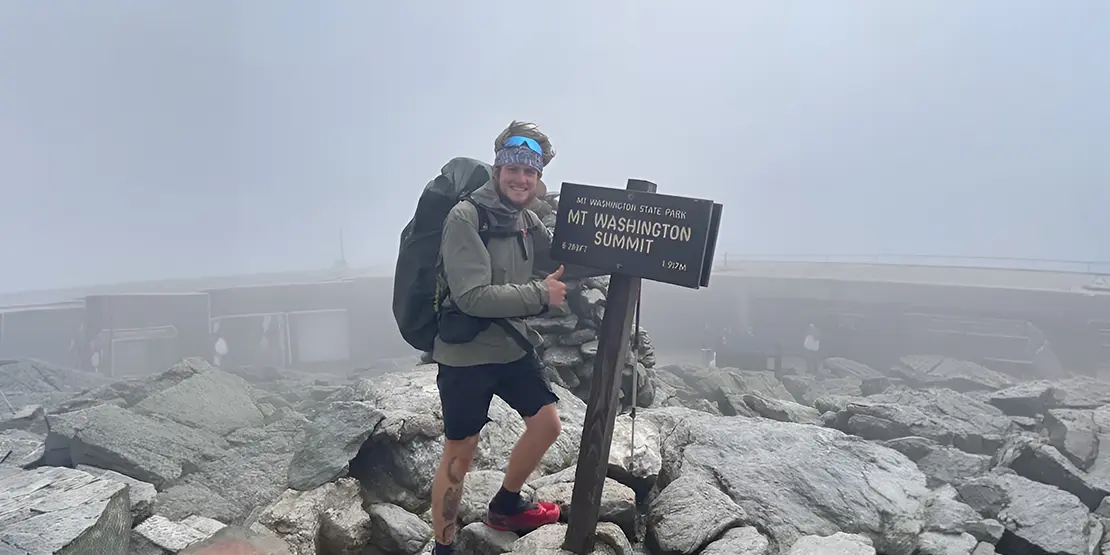
For some people, life is a chosen road to a known destination. For others like Geomatics student Austin Stryker, it’s hiking thousands of miles that leads to answers along the way. After a four-year stint in the U.S. Navy, A-B Tech Geomatics student Austin Stryker completed the vaunted Triple Crown of hiking while planning his eventual career path. His Triple Crown treks included the Appalachian Trail (2,200 miles) in 2022, the Pacific Crest Trail (2,600 miles) in 2024, and the Continental Divide Trail (3, 000 miles) in 2025.
Stryker also spent time between hikes working on a commercial crabbing boat off the coast of Washington and caring for his ailing grandfather in Florida.
Now 28, Stryker said he balked when asked for his two-year release plan in the Navy. “I didn’t feel like going to college,” he said. “I didn’t know what I wanted to study and didn’t want to study aimlessly and accumulate debt.”
His response was "Hike the Appalachian Trail", along with a list of planned expenses including food, hostel stays, and camping gear. A Washington native, Stryker had dreamed of hiking the trail as a way of getting through the tough times in the Navy. He also worked in ship maintenance, trained in small boat operations, and became proficient in running, lifting weights, and swimming. After he was discharged, he was in prime shape to fulfill his dream.
Stryker completed the Appalachian Trail (AT) in 5½ months, wending his way from Georgia to Maine. The journey yielded many gifts. He got to see the Northeast for the first time, dipping off the trail into small towns, sleeping in hostels and talking to locals. He learned how to efficiently plan his daily food intake, downsizing his backpack from 45 to 26 pounds. And he met new friends with trail names like Buck Eye, Whoopie, Pickles and Freight Train. One new friend nicknamed Miss Moss went on to become his trail mate and current girlfriend. But perhaps, most importantly, hiking the trail gave Stryker the gift of unstructured time.
“You get a lot of hours to think when you hike, so you can think through decisions,” he said. As he walked, Stryker pondered the food he ate, the places he saw, and the road that wound on ahead. A sea navigator by training, he also began to ponder the metal benchmarks used to mark the trails, metal pins cemented into summits or ridge lines that showed the elevation. “I thought how they are involved with surveying,” he said. “Then I thought how I might like to do surveying myself.”
As he walked the trail, people often asked him his reasons for tackling it. Stryker didn’t have a sure answer, so he began to make up his own. “I started blowing smoke that my dad was going to buy me tickets to the Daytona Racetrack when I finished,” he said, adding, “After a while, people started calling me 'Daytona' for my trail name.”
When Stryker finished the AT, he felt more certain of things. He knew he could take care of himself in challenging circumstances, that he hated the processed food he had to eat while hiking and wanted to learn how to grow his own food, and that he wanted to use his GI Bill to go to school for surveying.
Ultimately, Stryker landed in Asheville at A-B Tech to study Geomatics (surveying). Now in his third semester of the program, Stryker is set to finish in fall 2027. When he’s not in class or studying, he farms with his girlfriend at their place in Leicester. It’s the longest time he’s ever been in one place, and he is in heaven, growing peppers, tomatoes, zucchini, and eggplant. He also works in A-B Tech’s Vet Café, a hub for the college’s veterans, as a volunteer for 15 hours a week. He maintains the small kitchen with an array of snacks, cleans the workspace, and helps fellow veterans with local resources.
Stryker’s new two-year plan still doesn't sound traditional. He’d like to paddle the Mississippi with his girlfriend and get a job doing geomatics that will allow him the flexibility to go on the occasional adventure. He also hopes to go back to the Pacific Coast and Continental Divide trails to make up long stretches he missed because of forest fires. No matter that these parts of the trail were stripped of grass and strewn with blackened trees that lack canopy to shade hikers from sunlight. Stryker said it is important to go back because he’d like to experience every step of the journey, especially the most difficult parts.
To learn more, visit Geomatics Technology (Surveying).
Contact our Veterans Services Office at veteranservices@abtech.edu.