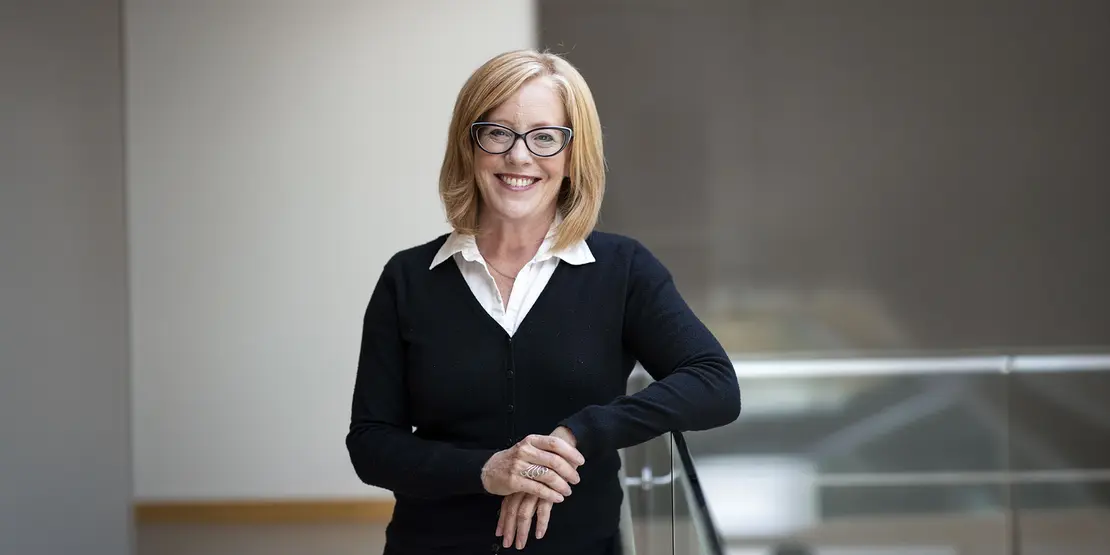
Sharon Bigger, 53, moved from the Washington, D.C., area to Asheville in her early twenties, hoping to land a job where she could use her language skills. Fluent in. Spanish, she’d spent time abroad in Latin America and the United States advocating for farm workers and working as a health educator.
Initially, she found it difficult to land her dream job despite her experience and took a position at a Hendersonville community health center as a bilingual front desk receptionist. It felt like a step down at first for Bigger, whose last name sums up her ambitious spirit. However, the job, which included Spanish language interpreting and basic hands-on patient work, ultimately turned out to be the perfect groundwork for her future career. After working with patients, she felt called to pursue nursing and explored A-B Tech’s nursing programs. In part, nursing appealed to her because of the wide variety of job options.
“I wanted to have flexibility in my career,” she said. “That’s part of my personality in general; I don’t want to feel confined.”
After exploring the program, Bigger learned she needed volunteer experience before being eligible for admission. She applied to Mountain Area Hospice to become a hospice volunteer and soon found a second home there. The experience helped her get into A-B Tech’s nursing program a year later. It also resonated with her on a spiritual level.
“Encountering people facing their own mortality really tends to illuminate the meaning of life for me,” she said.
After graduating from A-B Tech, Bigger worked with stroke patients for three years at Mission Hospital. In that role, she collaborated with the palliative care team to help inform end-of-life care decisions her patients made. Though she loved her day-to-day work, Bigger found she struggled in the hospital’s fast-paced environment. The bright lights, beeping machines, and “popcorning” from one patient to another all added up to exhaustion at the end of the day. Doubting her career choice, Bigger went to Mission’s HR department intending to resign.
“I said I don’t think I can be a nurse,” she said. “They said, ‘What would you do even if you didn’t get paid?’ I said, Well, hospice.”
More than two decades later, Bigger has carved out a highly satisfying and meaningful career in the hospice nursing field. As someone who values her freedom, she loves working outside of a hospital. Bigger compares walking into her various patients’ homes to a traveler’s experience visiting different countries.
“I can go see one patient and family for an entire hour and focus on them, then get back in my car with my music; drive around the countryside; process what happened; then go in to see the next family for an hour,” she said. “You try to step into their reality. People adapt as human beings to whatever situation they’re in. (You have to decide) what can we do to be useful? What is important to these people?”
In 2011, Bigger took a position as a hospice educator at Care Partners Hospice and Palliative Care, which required her to train staff including chaplains, nurses, and social workers. Realizing many in her role had advanced degrees, she decided to return to school for her BSN at Western Carolina University, where she fell in love with the academic side of her chosen field: “Getting the macro picture on what’s going on with policy, the role and value of nursing.”
While in school, Bigger worked as a hospice nurse, picking up hours as needed to pay the bills. She eventually completed East Tennessee State University’s BSN to PhD program and stayed on afterwards to teach for three years. She now juggles part-time hospice nursing with a remote role as a postdoctoral research fellow at the University of Utah.
Bigger has often drawn on her love for the Spanish language and Latinx culture. Over the years, she’s worked with ELNEC Mexico, a nonprofit based in Querétaro, to study how they do palliative and hospice care. Whereas in the United States, end-of-life training is primarily provided to nurses, in Mexico loved ones are fully trained to do the full gamut of care. This concept, she said, has opened her mind in new directions.
“Scholarships are available, and doctors, physical therapists, psychologists and family caregivers are all at the same workshops learning the principles of end-of-life care,” she said.
One of Bigger’s areas of special interest in research is improving communication between clinicians and patients whose first language is not English. This involves a healthcare interpreter, which can get complicated when a clinician must tell a patient they have a serious illness.
“Not all providers are experienced in communication with interpreters, and not all interpreters are trained in end-of-life care,” she said.
Bigger is currently consulting with a community advisory board made up of interpreters, palliative nurses and family members to gain insight into how to improve these difficult conversations. She has boiled down her gleanings to a pocket-sized card that she hopes will be used by clinicians as a tool to streamline the communication process.
“It would have steps that they could take when preparing to do a serious illness conversation,” she said. “Make sure you have an interpreter; meet with them ahead of time to connect with them about what the conversation is about; and, when in the room, make sure you face the patient and their family, not the interpreter.”
After more than two decades in the nursing field, Bigger believes that working both as a nurse and researcher is the best of both worlds. “I feel like my patient care informs my research and my research informs my patient care,” she said.